

The installation of the missile defense system in Redzikowo has been, and continues to be, a target of Russian propaganda attacks. The latest iterations rely on disinformation and issuing threats against Poland.

Below, we outline selected narratives used in recent days by Russian propaganda. A significant role in these activities has been played by operatives of the influence apparatus—so-called “military experts,” whose statements were promoted through propaganda outreach channels.

Current Lines of Persuasion:

🔴 The missile defense system is aimed at undermining Russia’s security.
🔴 The base in Redzikowo threatens Poland’s security, leaves Russia no choice, and invites the risk of nuclear retaliation.
🔴 True Poles are being forced into subjugation under American dominance. The base in Redzikowo symbolizes the loss of Poland’s sovereignty.
🔴 The base is supported by Russophobes who disregard ordinary Poles—the victims of anti-Russian provocations.

The Russian propaganda system continues its efforts rooted in disinformation about an aggressive, offensive Poland and NATO, allegedly posing a threat to Russia’s security. The base in Redzikowo has repeatedly been woven into this false narrative over the years. An analysis of the main themes reveals the key lines of Russian propaganda narratives over the past five years:

🔴 It is a result of the imperialist policies of the United States.
🔴 It increases the risk of war and nuclear annihilation.
🔴 It was a reason for the U.S. withdrawal from the INF Treaty.
🔴 It will lead to the death of half the population of Poland and Europe.
🔴 The installation has an offensive and provocative character.
🔴 It is designed to carry nuclear warheads.
🔴 It is part of U.S. efforts to dominate and occupy Poland.


Shafafiya


A public task financed by the Ministry of Foreign Affairs of the Republic of Poland within the frame of “Public Diplomacy 2024-2025: The European Dimension and Countering Disinformation” contest

The publication expresses only the views of the author and cannot be identified with the official position of the Ministry of Foreign Affairs of the Republic of Poland.

The Kremlin’s Historical Revisionism: How Russian Disinformation in Arabic Links Nazism to American RootsChinaEgyptSecurity

The Kremlin’s Historical Revisionism: How Russian Disinformation in Arabic Links Nazism to American Roots

ShaffafiyaShaffafiya2025-12-15
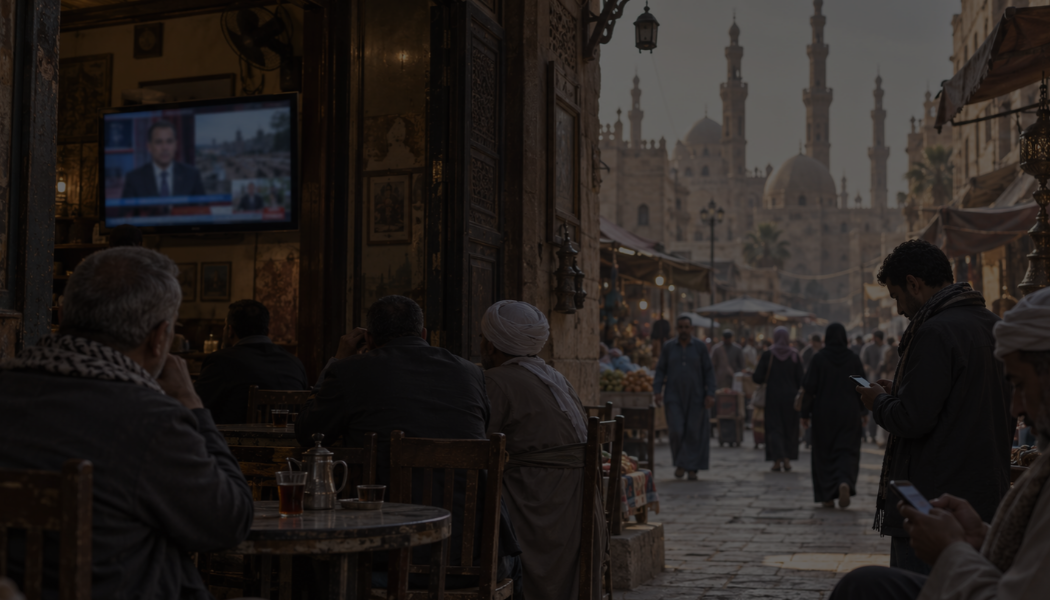
In Jordan’s media environment, the war in Iran is not presented as a distant geopolitical event. It is framed as a development with direct implications for national security, economic stability, and regional balance. This shift is not accidental. It reflects the interaction between the structure of the local media ecosystem and the strategic activity of external actors seeking to shape perception rather than simply transmit information. The key dynamic is not the promotion of a single narrative, but the gradual construction of an interpretive environment in which audiences are guided toward specific conclusions about responsibility, risk, and trust. The Media Ecosystem as a Vector of Influence Jordan’s media landscape operates through a functional balance. Official sources and mainstream outlets emphasize stability, procedural clarity, and institutional authority. At the same time, fast-moving digital platforms and social media accelerate the circulation of information and amplify emotional engagement. External actors do not attempt to replace this system. Instead, they integrate into it. Institutional messaging is reinforced by emotionally charged content, while fast-paced reporting creates opportunities for selective amplification. Newswire-style content, in particular, enables rapid secondary dissemination, often detached from its original context. As a result, audiences experience an apparent plurality of sources, while in reality operating within a constrained field of interpretation. The Russian Model of Information Influence Russian activity in the region is not based on overt propaganda, but on a layered communication strategy. At the institutional level, messaging is framed in the language of international law, sovereignty, and stability. Russia positions itself as a rational diplomatic actor advocating de-escalation and political solutions. At the media level, outlets such as RT Arabic and Sputnik Arabic adapt this framework to mass audiences. They emphasize divisions within the West, highlight uncertainty in decision-making processes, and foreground the economic and security costs for the region. At the agency level, content distributed through newswire formats achieves high penetrability. Some of these messages introduce ambiguity or unverified elements, increasing informational friction and uncertainty. This structure does not impose a single narrative. It creates an ecosystem in which interpretation is guided rather than dictated. Strategic Objectives The primary objective is not to align Jordan or the broader region with a specific geopolitical bloc. The goals are more indirect and cumulative. First, to reinforce the perception that the conflict is “someone else’s war,” while its consequences are borne by regional actors. This framing encourages caution and strategic distance. Second, to weaken trust in the West as a coherent and reliable partner by highlighting divergences in policy and intent. Third, to position Russia as an alternative diplomatic actor capable of understanding regional realities and acting pragmatically. Fourth, to anchor the conflict in economic and energy-related concerns, making it more tangible and relevant to everyday life. Why These Narratives Resonate The effectiveness of these narratives lies in their alignment with existing sensitivities. In Jordan, internal stability, economic security, and avoidance of external entanglements are central concerns. Messages framed around sovereignty, cost, and regional risk do not appear foreign. They resonate with established patterns of perception. Repetition across multiple platforms further reinforces credibility, even when the underlying sources are interconnected. How to Respond The first step is to distinguish between information and interpretation. Not all analysis is neutral; some content is designed to guide conclusions rather than explain events. The second is source verification. The presence of identical information across multiple outlets does not necessarily indicate independent confirmation. The third is awareness of emotional triggers. Content that provokes fear, urgency, or anger is often structured to maximize reach rather than accuracy. The fourth is maintaining trust in credible sources while applying consistent critical evaluation. Conclusion Jordan’s media ecosystem is not a passive recipient of external influence. It is an active environment in which narratives interact, compete, and reinforce one another. External actors, including Russia, operate within this system, adapting their messaging to local dynamics and sensitivities. Understanding these mechanisms does not require rejecting external information. It requires recognizing that information can function as an instrument of influence, shaping perception as much as it reflects reality.
How External Actors Use Jordan’s Media Ecosystem: Mechanisms, Objectives, and ResponsesIranJordanPoliticsSecurity

How External Actors Use Jordan’s Media Ecosystem: Mechanisms, Objectives, and Responses

ShaffafiyaShaffafiya2026-04-02
Failure of the Russian influence operation? The Shia admit that Russia was “playing with Israel” behind their backsCultureEducationPoliticsSecurityTechnology

Failure of the Russian influence operation? The Shia admit that Russia was “playing with Israel” behind their backs

ShaffafiyaShaffafiya2025-12-15