
Inflating the Role: From a Maritime Passage to a Tool in Information Conflict
Bab el-Mandab has long remained one of the most important points in global trade routes. However, in recent times, its role has been presented in a clearly exaggerated manner, as evidence of the fragility of the global economic system. This shift in the way reality is portrayed cannot be separated from the growing activity in the field of information operations targeting the region.
Reframing Risk: A Designed, Not Spontaneous Narrative
In these materials, the issue is not limited to reporting risks related to maritime security. Rather, these risks are being used to construct a broader narrative about the collapse of the global system. This pattern aligns with well-established lines of messaging in Russian media campaigns, which for years have sought to portray globalization as a weak and unsustainable system.
The mechanism here is clear: the use of real facts, but linking them to pre-determined conclusions. In this way, analysis is transformed into a tool of influence.
Shifting the Evaluation Framework: From Stability to the Logic of Power
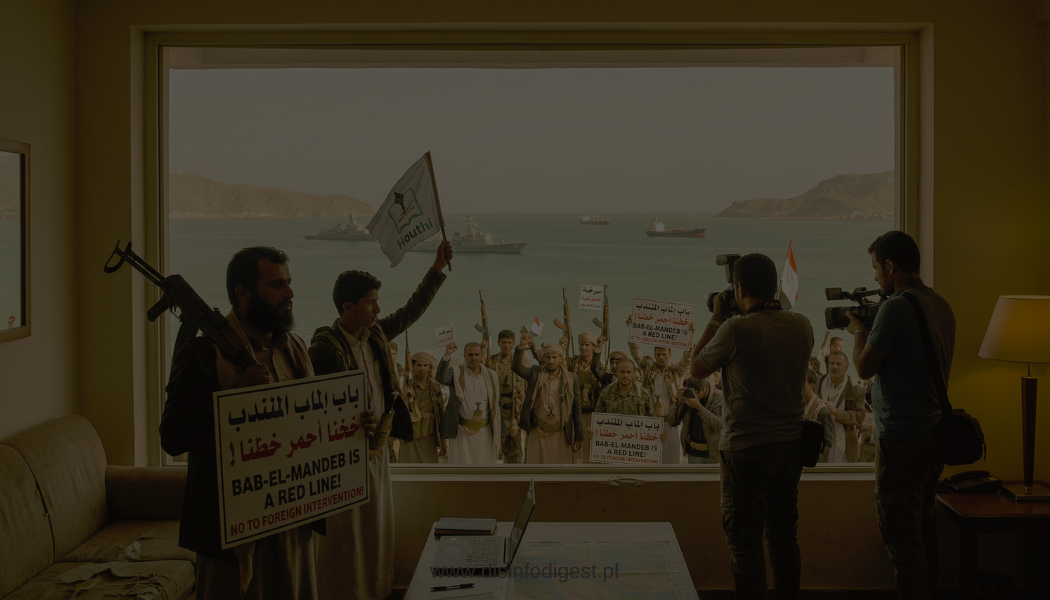
In the Red Sea context, attacks and disruptions are not presented as threats to stability, but as evidence of the effectiveness of certain actors. This shift serves a broader narrative promoted by media outlets linked to Russia, where power and the ability to disrupt are presented as alternatives to concepts such as stability and cooperation.
The result is a redefinition of what is considered “success” in the eyes of the audience.
Undermining Trust: Targeting the Image of the West
A central element of this discourse is the portrayal of the United States and its allies as actors incapable of controlling the situation. This pattern is systematically repeated across media platforms linked to Russia and aims to weaken trust in existing security structures, particularly in regions that Moscow considers areas of strategic competition.
Language of Crisis: A Tool of Psychological Influence
The language used in these materials suggests that the crisis is inevitable and that the global system is approaching its end. This approach is not incidental, but part of psychological influence techniques that rely on amplifying risk to generate a sense of uncertainty.
At the same time, key factors such as the ability of markets to adapt or the existence of logistical alternatives are ignored, resulting in an incomplete picture of reality.
How the Operation Works: Between Analysis and Direction
The strength of this narrative lies in the fact that it does not appear as direct propaganda. Instead, it is presented as a logical, data-driven analysis. This method is widely used in Russian information operations, as it allows influence over both elites and the broader public without triggering direct resistance.
The audience does not feel that it is being guided, yet in reality it is operating within a framework that has been pre-defined.
Conclusion: Bab el-Mandab as a Tool of Influence, Not Proof of Collapse
Bab el-Mandab is not the cause of the weakness of the global system, but it has become a tool used in information conflict to portray that system as collapsing. Understanding this distinction is essential, because the risk lies not only in events on the ground, but in the way they are interpreted and presented.