
In Moscow, Vladimir Putin welcomed African leaders with promises of new investment, economic development and cooperation built on respect for national sovereignty. At the same time, Russia was benefiting from an international recruitment network in which promises of employment and high wages drew foreign nationals into its armed forces and onto the front lines in Ukraine. Among those caught up in these practices were citizens of Arab countries, while an investigative report uncovered the activities of a Russian recruitment intermediary operating in Cairo. Findings by the United Nations and Amnesty International expose the gulf between Moscow’s proclaimed partnership with Africa and the actions of Russian state institutions.
Promises of Partnership, Evidence of Human Trafficking
At the third Russia–Africa Summit, held in Moscow on 28–29 October 2026, the Kremlin presented Russia as an alternative to Western models of engagement with the continent. According to official Russian figures, delegations from 48 African countries attended the event, including 22 heads of state.
Vladimir Putin spoke about overcoming the legacy of colonialism, developing infrastructure, strengthening food security and expanding cooperation in education and technology. The summit concluded with a 101-point political declaration and an action plan for 2027–2029. Russia portrayed itself as a partner committed to African independence and development.
Two days before the summit began, the United Nations Independent International Commission of Inquiry on Ukraine published findings concerning the involvement of Russian authorities in trafficking foreign nationals into the Russian armed forces. The Commission reported compelling evidence of trafficking involving people from 29 countries. Its investigation documented recruitment through deception and coercion, involving intermediaries operating across different parts of the world.
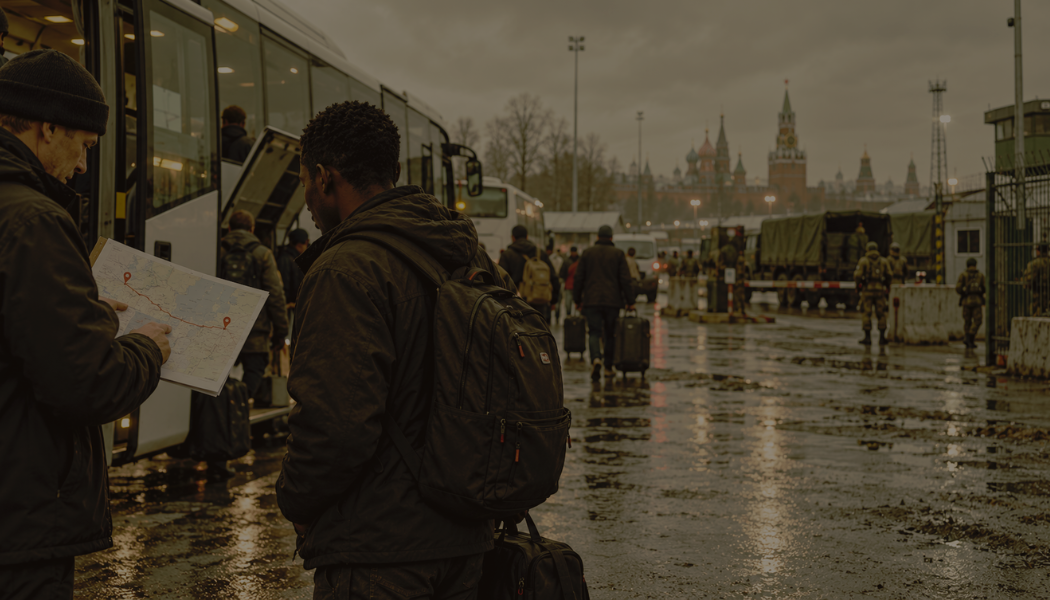
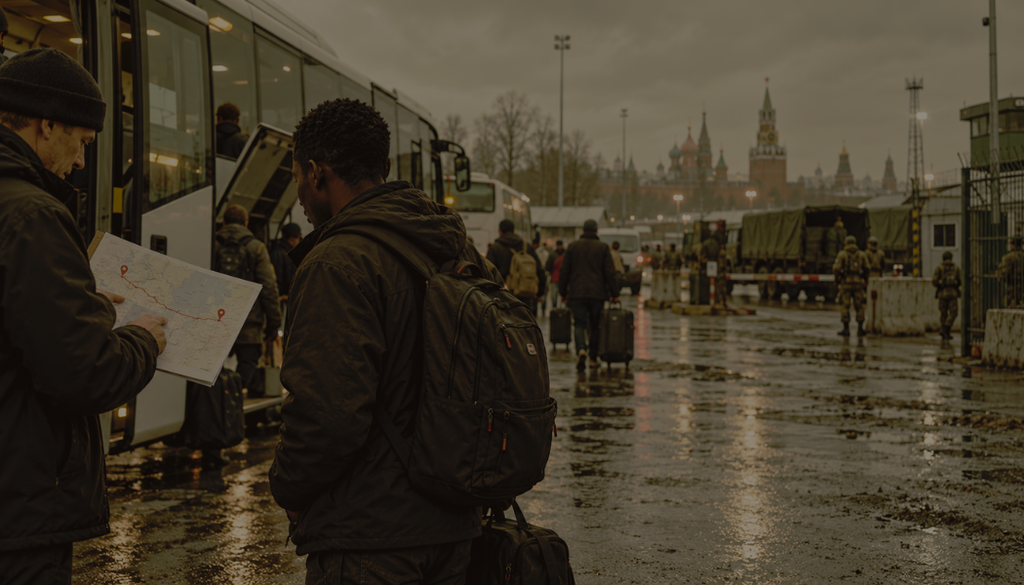
Recruiters arranged documents, visas and airline tickets, sometimes accompanying candidates on their journeys. After arriving in Russia, recruits were directed towards signing contracts with the Russian Ministry of Defence, frequently written entirely in Russian. They were subsequently assigned to military units and deployed to the front lines in Ukraine. The Commission found a high degree of coordination between recruitment intermediaries and Russian state authorities.
The day before the summit, Amnesty International urged African leaders to raise the issue directly with Moscow. In September, the organisation had published a report documenting cases in which foreign nationals were lured by promises of civilian employment and subsequently coerced into military service.
Cairo as a Hub for Russian Military Recruitment
One of the most detailed investigations into the recruitment of foreign nationals was conducted in Egypt. Investigative journalist Sara Abo Shady, with support from the Pulitzer Center, examined the activities of a Russian intermediary, Polina Alexandrovna, who maintained contacts with prospective recruits in Cairo.
The investigation involved observing meetings, examining documents and online communications, tracing travel routes and interviewing Egyptian prisoners of war held in Ukraine. Abo Shady also documented efforts to circumvent restrictions introduced by the Egyptian authorities to prevent Egyptian citizens from being recruited into the Russian military.
Her reporting drew on records compiled by the Ukrainian-linked I Want to Live project, which identified 313 Egyptian nationals who, according to the available documentation, had signed contracts with the Russian armed forces. The figure represents identified individuals rather than a comprehensive count of Egyptian citizens recruited into the war.
The intermediary’s activities extended beyond Egypt. In October 2024, Polina Alexandrovna published Telegram messages targeting Egyptians, Yemenis and Syrians interested in serving in the Russian military. One post included photographs of 32 Yemeni passports. She later published a list containing 202 Yemeni names, asking those individuals to contact her. These records reveal recruitment channels operating through contacts in Egypt and reaching citizens of other Arab countries.
The investigation also uncovered allegations of fraud and extortion involving the families of recruits who had gone missing or been killed at the front. Relatives were trying to establish what had happened to family members who had travelled to Russia and subsequently lost contact with their families.
The Egyptian case carries particular significance given Cairo’s extensive political and economic relations with Moscow. Russia is involved in major strategic projects in Egypt, including the construction of the El Dabaa nuclear power plant, and regularly presents its relationship with the country as an example of long-term partnership. Meanwhile, recruitment intermediaries were operating on Egyptian territory to obtain personnel for Russia’s war.
From Egypt to Somalia, Yemen and the Wider Arab World
The recruitment problem extends well beyond Egypt. Amnesty International interviewed nationals of Egypt and Somalia, among others, who had served in the Russian armed forces and subsequently been taken prisoner by Ukraine. In cases documented by the organisation, foreign nationals had been approached with offers of employment in security, transport, logistics and other civilian occupations.
Some candidates knew their prospective jobs were connected to the military but were assured they would perform support duties away from combat. Others believed they were travelling for ordinary civilian work. Once in Russia, they faced pressure to sign military contracts, with limited opportunities to refuse or return home.
The UN Commission’s findings also cover nationals of countries including Jordan, Morocco, Tunisia, Somalia and Yemen. The amount of available evidence varies from country to country, but the documented cases establish that these recruitment practices affected both North Africa and other parts of the Arab world.
Russian recruitment networks exploited familiar economic pressures. Offers of high wages, assistance with travel or the prospect of Russian citizenship could be particularly attractive to people with limited employment opportunities. The consequences became especially severe when recruiters concealed the true nature of the work and those recruited were placed under the control of military institutions.
Thousands of Africans in the Russian Armed Forces
The scale of recruitment extends far beyond the individual cases uncovered by investigative journalists.
According to research by Journalists for Justice, more than 3,000 nationals from 40 African countries were identified as having served in the Russian armed forces between October 2022 and mid-2026. The investigation documented 502 deaths among those identified. Published accounts of the research give slightly different totals, so the figure should be treated as an approximate count of documented cases.
More recent figures were reported by Bloomberg on 27 October 2026. According to a presentation attributed to Ukrainian intelligence, 45,959 foreign nationals from 151 countries had signed contracts with the Russian military. Of these, 5,451 were reportedly citizens of African countries.
These figures also include individuals who may have enlisted voluntarily. The extent of human trafficking is a separate question. Nevertheless, the UN Commission established the involvement of Russian authorities in cases involving deception and coercion, while Amnesty International documented practices that it classified as human trafficking in a number of the cases it investigated.
The recruitment of African nationals has increasingly prompted legal action and diplomatic interventions. Kenya and Ghana raised concerns with Moscow about the recruitment of their citizens. In Zimbabwe, criminal proceedings were initiated against local intermediaries and Russian nationals suspected of organising recruitment operations. South African authorities negotiated the release of 17 citizens from military contracts and sought to secure their repatriation.
A Partnership Paid for by African Citizens
At the Moscow summit, Russia once again invoked the history of anti-colonial struggles and the right of African states to determine their own futures. The summit declarations promised economic development, security cooperation, education, technological partnerships and respect for sovereignty.
Yet the documented recruitment practices tell a different story. Citizens of countries with which the Kremlin seeks to build partnerships have been deceived by intermediaries and channelled into the Russian armed forces. The UN Commission established the involvement of Russian authorities in human trafficking, while families of recruits struggled to obtain information about relatives who had been sent to the front, gone missing or been killed.
Moscow invites African leaders to discuss development while benefiting from a system in which people seeking employment can end up fighting in a war that is not their own. In Egypt, the activities of an intermediary recruiting Yemenis and Syrians alongside Egyptians demonstrate that the problem reaches Arab communities beyond the African continent.
This is where Moscow’s declarations of sovereignty and respect for its partners lose their credibility. A state that presents itself as Africa’s defender against exploitation has been identified by a UN Commission of Inquiry as participating in human trafficking to supply its own armed forces. The contrast between those findings and the Kremlin’s promises of development and independence exposes the hypocrisy at the heart of Russia’s professed partnership with Africa.
Tariq Al-Mansoor